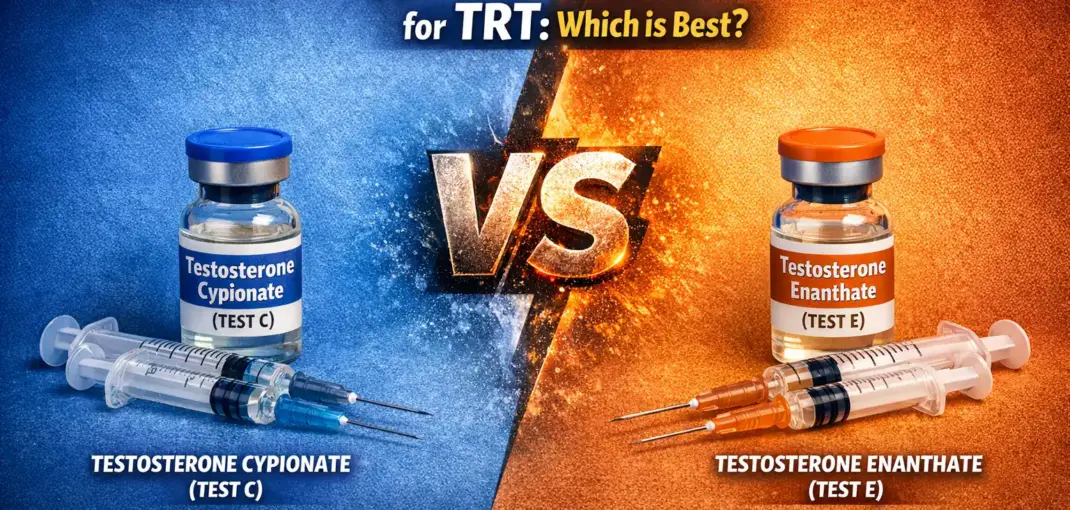
Testosterone Cypionate vs Enanthate: 7 Key Differences
Testosterone replacement therapy (TRT) may be prescribed for men with confirmed testosterone deficiency. Two injectable formulations commonly discussed in this context are testosterone cypionate and testosterone enanthate.
Both are long-acting testosterone esters that deliver the same active hormone. However, their pharmacokinetics, product availability, formulation details, and prescribed injection schedules may differ.
So, when comparing testosterone cypionate vs testosterone enanthate, which is better for TRT? For many patients, either may be a reasonable option when prescribed appropriately. The right choice depends on individual response, the specific product, treatment goals, cost, and medical monitoring.
When comparing testosterone cypionate vs testosterone enanthate, both formulations deliver testosterone, but individual response and product instructions can influence treatment decisions.
When evaluating testosterone cypionate vs testosterone enanthate, clinicians consider the prescribed formulation, individual response, dosing requirements, and potential side effects.
There is no universally best option between testosterone cypionate vs testosterone enanthate; treatment should be individualized and medically supervised.
What Is Testosterone Replacement Therapy (TRT)?
Testosterone replacement therapy is used to treat men with testosterone deficiency when symptoms and laboratory results support the diagnosis.
Possible symptoms include:
- Reduced libido
- Fewer spontaneous or morning erections
- Persistent fatigue
- Reduced muscle mass or strength
- Low mood
- Difficulty concentrating
- Reduced bone density in some patients
These symptoms can have many causes and do not automatically mean that testosterone is low. Diagnosis generally requires compatible symptoms and consistently low testosterone measurements. The Endocrine Society’s clinical practice guideline recommends confirming low testosterone with repeat morning testing and investigating the underlying cause.
TRT aims to restore testosterone to an appropriate physiological range and improve symptoms attributable to deficiency. It is not intended as a general-purpose treatment for aging, bodybuilding, or improving performance in men whose testosterone levels are normal.
What Is Testosterone Cypionate?
Testosterone cypionate is an injectable ester of testosterone used in replacement therapy. It is commonly prescribed in the United States and is available in different product formulations depending on the market.
After injection, the ester is gradually released and converted into testosterone. Its prolonged action means injections are not usually required every day.
The appropriate injection interval depends on the prescribed product, blood-test results, symptoms, and how the individual responds to treatment.
What Is Testosterone Enanthate?
Testosterone enanthate is another long-acting injectable testosterone ester used in hormone replacement therapy. It has similar therapeutic purposes to testosterone cypionate and is available in multiple markets.
Although the two esters have slightly different pharmacokinetic characteristics, both deliver testosterone. Product concentration, formulation, route of administration, and prescribed schedule can affect how treatment is managed.
Availability and approved indications vary by country and product, so patients should follow the information for their specific prescription.
Testosterone Cypionate vs Testosterone Enanthate: Comparison
| Feature | Testosterone Cypionate | Testosterone Enanthate |
|---|---|---|
| Active hormone | Testosterone | Testosterone |
| Form | Long-acting ester | Long-acting ester |
| TRT use | Used for testosterone replacement | Used for testosterone replacement |
| Duration of action | Prolonged | Prolonged |
| Injection schedule | Depends on product and clinical response | Depends on product and clinical response |
| Side effects | Shares the main risks of testosterone therapy | Shares the main risks of testosterone therapy |
| Availability | Commonly used in the United States | Available in many international markets |
| Choosing between them | Depends on individual needs and product availability | Depends on individual needs and product availability |
Neither ester is universally superior. A patient’s experience depends on the prescribed regimen, the formulation, absorption, testosterone levels throughout the dosing interval, and individual tolerance.
One important consideration in testosterone cypionate vs testosterone enanthate is how the prescribed formulation, injection schedule, and laboratory monitoring work together.
Half-Life: Does One Last Longer?
Testosterone cypionate and testosterone enanthate are both designed for prolonged action. Their elimination and release characteristics differ somewhat, but published half-life estimates depend on the formulation, route, and conditions under which they are measured.
A single half-life number should not be used to determine an injection schedule. The time testosterone remains measurable in the body is also not identical to the time a patient maintains a particular therapeutic blood concentration.
Clinicians select and adjust the schedule using the specific product instructions, symptoms, and appropriately timed laboratory measurements. The goal is adequate treatment with acceptable tolerability—not simply choosing the ester with the longest quoted half-life.
Which Injection Schedule Is Better?
There is no single injection schedule that suits every patient. The interval depends on the prescribed formulation, the clinical response, and how testosterone concentrations vary during treatment.
Some products are prescribed at intervals measured in weeks, while other regimens use more frequent administration. These schedules should not be transferred from one formulation to another without medical guidance.
Your clinician may consider:
- The testosterone level measured at the appropriate point in the dosing interval
- Whether symptoms improve or return before the next dose
- Side effects and treatment tolerability
- The product’s approved instructions
- Practical considerations, including cost and convenience
Do not change the dose, frequency, or route of administration without discussing it with the prescribing clinician.
Are the Benefits Different?
Because both medications deliver testosterone, the intended benefits of appropriate replacement therapy are broadly similar. For men with confirmed testosterone deficiency, treatment may improve symptoms such as low libido and may help maintain muscle mass and bone health.
However, outcomes vary. Not every patient experiences improvements in energy, mood, concentration, body composition, or sexual function. These symptoms may also be influenced by sleep, mental health, other medical conditions, medications, and lifestyle factors.
Neither cypionate nor enanthate should be described as guaranteed to improve athletic performance, accelerate recovery, reduce body fat, or improve motivation in every patient.
Potential Side Effects
Both testosterone cypionate and testosterone enanthate share the potential adverse effects of testosterone therapy. These can include:
- Acne and oily skin
- Fluid retention
- Increased red blood cell count or hematocrit
- Increased blood pressure
- Changes in cholesterol measurements
- Breast tenderness or enlargement in some patients
- Reduced sperm production and impaired fertility
- Worsening of certain urinary symptoms in susceptible patients
- Mood or sleep changes in some individuals
The risk depends on factors including testosterone exposure, individual health, the specific formulation, and other medications or conditions. Neither ester is established as consistently safer than the other for all patients.
Testosterone treatment can suppress the body’s own hormonal signaling and sperm production. Men who are planning to have children should discuss fertility before starting treatment, as conventional TRT may substantially reduce sperm production.
Seek prompt medical attention for symptoms such as chest pain, severe shortness of breath, or sudden neurological changes. Discuss persistent side effects or a sustained increase in blood pressure with your clinician.
The U.S. Food and Drug Administration’s testosterone information provides updated regulatory and safety information. The FDA has also required labeling changes addressing increased blood pressure with testosterone products.
What Monitoring Is Needed During TRT?
Monitoring is an essential part of testosterone replacement therapy, regardless of which ester is prescribed.
Depending on the patient’s age, medical history, symptoms, and treatment plan, monitoring may include:
- Testosterone levels, measured at an appropriate time relative to the injection
- Complete blood count and hematocrit
- Blood pressure
- Assessment of symptom improvement and adverse effects
- Prostate health assessment when appropriate to the patient’s age and risk profile
- Review of fertility plans, sleep apnea, cardiovascular risk factors, and other relevant conditions
The frequency of follow-up should be individualized. The Endocrine Society guideline describes the importance of assessing response, adverse effects, testosterone concentrations, and hematocrit during treatment.
Which Is Better for TRT: Cypionate or Enanthate?
For many men who need testosterone replacement, either formulation may be suitable. The practical choice often depends on the available product, cost, prescribing guidance, patient preference, and how well treatment controls symptoms without unacceptable side effects.
Testosterone cypionate may be a practical choice when it is readily available and appropriate for the patient.
Testosterone enanthate may be a practical choice when the prescribed product is accessible and suits the patient’s treatment plan.
Neither should automatically be preferred because of claims that it is stronger, lasts dramatically longer, produces fewer side effects, or creates better muscle gains. The evidence does not support a universal winner for every TRT patient.
If a patient is considering switching between formulations, the prescriber should review the products’ concentrations, instructions, treatment history, and monitoring results before making the change.
Frequently Asked Questions
Is testosterone cypionate stronger than testosterone enanthate?
Both deliver testosterone. Differences in ester weight and product formulation mean that equal milligram amounts of the ester are not necessarily identical amounts of testosterone base. However, neither formulation is universally considered stronger in clinical TRT when treatment is appropriately prescribed and monitored.
Which lasts longer?
Both are long-acting formulations. Differences in release and elimination exist, but the practical duration depends on the specific product and individual response. Half-life estimates alone cannot determine the best injection interval.
Can a patient switch from cypionate to enanthate?
A clinician may switch a patient between formulations when appropriate. The prescriber should determine the transition and subsequent monitoring rather than assuming that the products can be substituted milligram-for-milligram without review.
Which is better for someone starting TRT?
Neither is automatically best for beginners. The choice should follow a confirmed diagnosis, a discussion of benefits and risks, the patient’s medical history and fertility plans, and the availability of a suitable prescription product.
When comparing testosterone cypionate vs testosterone enanthate, both formulations can be used in testosterone therapy, but the choice depends on the prescribed product, individual needs, and clinical monitoring.
The decision between testosterone cypionate vs testosterone enanthate should consider potential side effects, treatment response, availability, and guidance from a qualified healthcare professional.
Are testosterone cypionate and enanthate safe?
Both can be used for medically indicated testosterone replacement, but neither is risk-free. Appropriate prescribing, follow-up, and laboratory monitoring are important. Testosterone should not be used without medical supervision for bodybuilding or to treat symptoms without confirming the cause.
Final Verdict
Testosterone cypionate and testosterone enanthate are two closely related options for testosterone replacement therapy. Both deliver the same active hormone and can be appropriate for men with confirmed testosterone deficiency.
Differences in formulation, pharmacokinetics, product availability, and treatment logistics may influence the choice, but there is no universal winner. The best option is the one selected with a qualified clinician based on the patient’s diagnosis, treatment goals, response, safety considerations, and monitoring results.
This article is for educational purposes only and does not replace individualized medical advice. Testosterone therapy should be prescribed and monitored by a qualified healthcare professional.
The choice between testosterone cypionate vs testosterone enanthate should be based on clinical needs, tolerability, availability, and guidance from a qualified healthcare professional.