Peptides in Sports: 7 Essential Facts & Benefits
Peptides in sports have attracted growing interest in sports science because of their roles in biological signalling, metabolism, growth-related pathways and tissue biology. Different peptides are studied for their distinct molecular properties and potential applications in biomedical research, exercise science and recovery-related research.
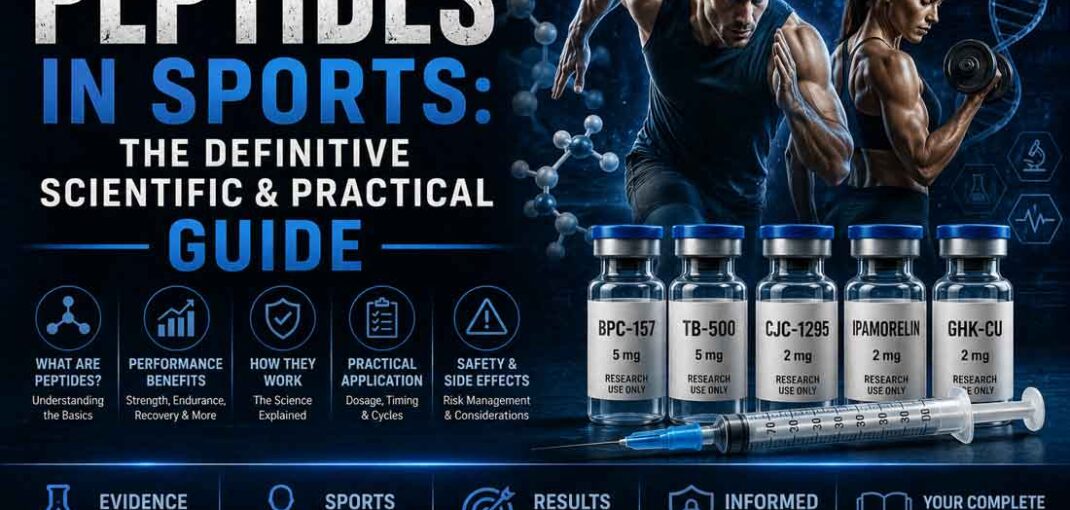
This guide explores the main categories of peptides in sports, including BPC-157, TB-500, GHK-Cu, CJC-1295, ipamorelin and IGF-1-related compounds. It highlights their key research areas, biological functions and relevance to sports science.
For an overview of peptide-related products and research categories, explore our peptides and SARMs research catalog.
Peptides in Sports: What Are They?
Peptides are short chains of amino acids connected by peptide bonds. Naturally occurring peptides play important roles in the human body, acting as hormones, signalling molecules and regulators of various cellular processes.
In sports science, peptides are of interest because different molecules interact with specific biological pathways. Depending on their structure and function, researchers investigate their roles in growth hormone signalling, metabolic regulation, cellular activity, tissue biology and muscle-related processes.
The diversity of peptide compounds makes this category relevant to several areas of scientific investigation. Understanding their individual properties helps researchers distinguish between different molecular mechanisms and potential applications.
1. Peptides for Recovery and Tissue Research
Recovery-related research is an important area of peptide science. Tendons, ligaments, connective tissue and skeletal muscle involve complex biological processes, including cellular migration, vascular signalling, collagen regulation and tissue remodelling.
Several peptides have attracted research interest because of their relationship with these biological mechanisms.
BPC-157
BPC-157 is a synthetic peptide investigated primarily in preclinical research involving tissue biology and gastrointestinal processes. Researchers have explored its potential interactions with cellular signalling, vascular pathways and mechanisms associated with tissue maintenance.
Its distinctive research profile has made BPC-157 a frequently discussed compound in peptide research and sports-science communities.
BPC-157 continues to attract scientific interest, particularly in studies examining biological pathways associated with tissue function. Further well-designed human research is needed to establish its clinical applications.
TB-500 and Thymosin-β4
Thymosin-β4 is a naturally occurring peptide associated with cellular processes such as actin regulation and cell migration. These functions have made it an interesting subject in research involving cellular movement and tissue biology.
TB-500 is commonly discussed alongside Thymosin-β4 in peptide research. Interest in this area centres on the relationship between peptide signalling, cellular activity and tissue-related biological processes.
For sports-science readers, this category provides an opportunity to explore how researchers investigate cellular mechanisms associated with tissue maintenance and remodelling.
GHK-Cu
GHK-Cu is a copper-binding peptide that has been investigated for its role in skin biology, extracellular matrix regulation and tissue remodelling.
Its research profile includes interactions involving copper and biological processes associated with cellular environments and structural components of tissue. GHK-Cu is also recognised in cosmetic and skin-related research.
These characteristics distinguish GHK-Cu from peptides primarily studied for growth hormone signalling or metabolic pathways, making it a notable compound within the broader peptide research category.
2. Peptides and Metabolic Research
Metabolic and endocrine research represents another important area of peptides in sports. Certain peptides interact with pathways associated with growth hormone secretion, energy regulation and body composition.
Studying these compounds helps researchers investigate how hormonal signalling operates and how different molecules interact with specific physiological systems.
CJC-1295 and GHRH-Related Peptides
CJC-1295 is a growth hormone-releasing hormone (GHRH) analogue studied for its effects on growth hormone secretion.
GHRH-related compounds are of interest in endocrine research because they interact with pathways involved in hormonal regulation. Research in this area helps scientists understand the relationship between peptide signalling and growth hormone physiology.
CJC-1295 has consequently become a commonly discussed compound in the wider peptide research field.
Ipamorelin and GHRP-Related Compounds
Ipamorelin and other growth hormone secretagogues are studied for their interactions with pathways associated with the growth hormone secretagogue receptor.
These compounds are relevant to research exploring hormonal signalling, receptor activity and physiological responses associated with growth hormone release.
Their distinct molecular properties make them useful subjects for understanding the different mechanisms through which peptide-related compounds interact with endocrine pathways.
Tesamorelin
Tesamorelin is a GHRH analogue with an established medical application for reducing excess abdominal fat in adults with HIV-associated lipodystrophy.
Its clinical application illustrates how peptide-based compounds can be developed for specific medical purposes. Tesamorelin is therefore relevant to research and educational discussions involving endocrine signalling and metabolic regulation.
Its established indication is specific, and it should be distinguished from experimental compounds marketed for general sports performance.
3. Peptides, Muscle Growth and IGF-1 Pathways
Insulin-like growth factor 1 (IGF-1) plays important physiological roles in growth, metabolism and tissue development. Its signalling pathway is an important subject in research involving cellular growth and muscle physiology.
Peptides and related compounds associated with this pathway are frequently discussed in biomedical research and sports science.
IGF-1 and Related Analogues
IGF-1-related compounds have been investigated because IGF signalling influences cellular growth and protein metabolism.
Experimental analogues such as IGF-1 LR3 are also discussed in research and bodybuilding communities. Their relevance lies in the scientific interest surrounding growth-factor signalling and its relationship with cellular processes.
Research into IGF-1 pathways helps explain the complex interactions between growth signals, metabolism and tissue development.
Follistatin and Myostatin Research
Myostatin is a member of the transforming growth factor beta family and plays an important role in regulating skeletal muscle development. Follistatin can interact with members of this signalling system.
These interactions have generated scientific interest in the molecular regulation of muscle biology and the pathways involved in muscle development.
Research in this field contributes to a broader understanding of the biological mechanisms that regulate skeletal muscle growth and function.
4. Key Categories of Peptides in Sports
Different peptide compounds are associated with distinct areas of scientific investigation. The following table provides a concise overview of commonly discussed peptides and their principal research areas.
| Peptide or Class | Main Research Area | Key Research Focus |
|---|---|---|
| BPC-157 | Tissue and gastrointestinal biology | Cellular signalling and tissue-related mechanisms |
| TB-500 / Thymosin-β4 | Cell migration and tissue biology | Cellular movement and tissue-related processes |
| GHK-Cu | Skin and extracellular matrix biology | Copper-binding properties and tissue remodelling |
| CJC-1295 | Growth hormone signalling | Endocrine pathways and hormonal regulation |
| Ipamorelin | Growth hormone secretion | Receptor activity and hormonal signalling |
| Tesamorelin | Endocrine and metabolic research | Growth hormone-releasing pathways and its specific medical application |
| IGF-1-related compounds | Growth and metabolic signalling | Cellular growth and protein metabolism |
| MGF-related compounds | Muscle and growth-factor research | Growth-factor pathways and muscle biology |
This overview illustrates the variety of mechanisms represented within the peptide category. Each compound has its own molecular characteristics and research profile, making individual evaluation important.
5. Key Features of Peptides in Sports Research
Peptides attract scientific interest because they interact with a wide range of biological systems. Several characteristics help explain their relevance to biomedical and sports-science research.
- Targeted biological signalling: Different peptides interact with specific receptors, signalling molecules or physiological pathways.
- Diverse research applications: Peptide research spans tissue biology, endocrine regulation, metabolism, skin science and muscle physiology.
- Distinct molecular properties: Variations in peptide structure influence their biological activity and research applications.
- Growth-related pathways: Certain compounds are investigated for their relationship with growth hormone and IGF-1 signalling.
- Cellular research potential: Peptides such as Thymosin-β4 and GHK-Cu are studied in connection with cellular processes and tissue biology.
- Expanding scientific interest: Continuing research helps improve understanding of peptide mechanisms and their possible applications.
The scientific significance of a peptide depends on the specific molecule, the biological process being studied and the quality of available evidence. Research findings should be interpreted according to the particular compound and application.
6. Peptides in Sports and WADA Anti-Doping Rules
For competitive athletes, understanding anti-doping regulations is an important part of sports science.
The 2026 World Anti-Doping Agency (WADA) Prohibited List includes several peptide hormones, growth factors, related substances and mimetics. Category S2 covers specified substances prohibited both in and out of competition.
Examples of relevant compounds include:
- CJC-1295 and certain other growth hormone-releasing hormone analogues.
- Tesamorelin.
- Ipamorelin and several growth hormone secretagogues.
- IGF-1 and its analogues.
- Mechano growth factors and Thymosin-β4 derivatives such as TB-500.
- Certain growth hormone fragments, including AOD-9604.
BPC-157 is listed separately under Category S0, which covers non-approved substances.
The official WADA list is the appropriate reference for checking the status of an individual compound. Athletes should consult the current rules and their relevant anti-doping organisation when assessing a substance.
For details, visit the official 2026 WADA Prohibited List.
7. Why Are Peptides Important in Sports Science?
Peptides provide researchers with opportunities to investigate a wide range of biological mechanisms relevant to human physiology.
Their importance in sports science comes from the diversity of pathways they interact with, including growth hormone signalling, cellular activity, metabolism, tissue biology and muscle-related processes.
Different compounds offer different research perspectives. For example, GHK-Cu is studied in skin and extracellular matrix biology, while CJC-1295 and ipamorelin are associated with endocrine signalling research. BPC-157 and Thymosin-β4-related compounds are discussed in studies of tissue biology and cellular processes.
Understanding these distinctions helps readers evaluate peptide categories according to their molecular properties and scientific context rather than treating all peptides as a single group.
The level of evidence and the permitted status of each compound should be considered separately from its research interest or popularity.
Frequently Asked Questions About Peptides in Sports
What are peptides in sports?
Peptides in sports refers to peptide compounds discussed or investigated in relation to exercise science, metabolism, growth-related signalling, tissue biology and other physiological processes. Different peptides have different molecular properties and research applications.
Which peptide categories are studied in sports science?
Commonly discussed categories include tissue-related research peptides, growth hormone-releasing hormone analogues, growth hormone secretagogues, copper-binding peptides and IGF-1-related compounds.
What is BPC-157 studied for?
BPC-157 is primarily investigated in preclinical research involving tissue biology and gastrointestinal processes. Researchers have explored its relationship with cellular signalling and pathways associated with tissue function.
What is the difference between GHK-Cu and growth hormone-related peptides?
GHK-Cu is a copper-binding peptide investigated in skin biology and extracellular matrix research. Growth hormone-related peptides, such as CJC-1295 and ipamorelin, are studied in connection with endocrine signalling and growth hormone pathways.
What is the role of IGF-1 in sports science?
IGF-1 is involved in growth, metabolism and tissue development. Research into IGF-1 signalling helps scientists understand cellular growth and protein metabolism.
Where can I find reliable information about peptide research?
Scientific publications, official regulatory resources and established medical information sources provide useful starting points. The relevance of a finding depends on the specific compound, the study design and the biological outcome being investigated.
Conclusion: Exploring Peptides in Sports Science
Peptides in sports represent a diverse area of biomedical and sports-science research. Compounds such as BPC-157, TB-500, GHK-Cu, CJC-1295, ipamorelin and IGF-1-related molecules are investigated for their distinct interactions with biological pathways.
Their research areas span cellular activity, tissue biology, endocrine signalling, metabolism, skin science and muscle physiology. Understanding the individual characteristics of each compound provides a clearer picture of the wider peptide research landscape.
For readers exploring peptide-related product categories, scientific context, molecular characteristics and relevant regulatory information are useful starting points for evaluating available research.
Explore our peptides and SARMs research catalog to learn more about the different compounds and research categories featured in this field.
Research information: This article provides general educational information about peptide science. Research interest does not establish a clinical benefit or approval for a particular use. Product status and applicable regulations should be verified for each compound.