
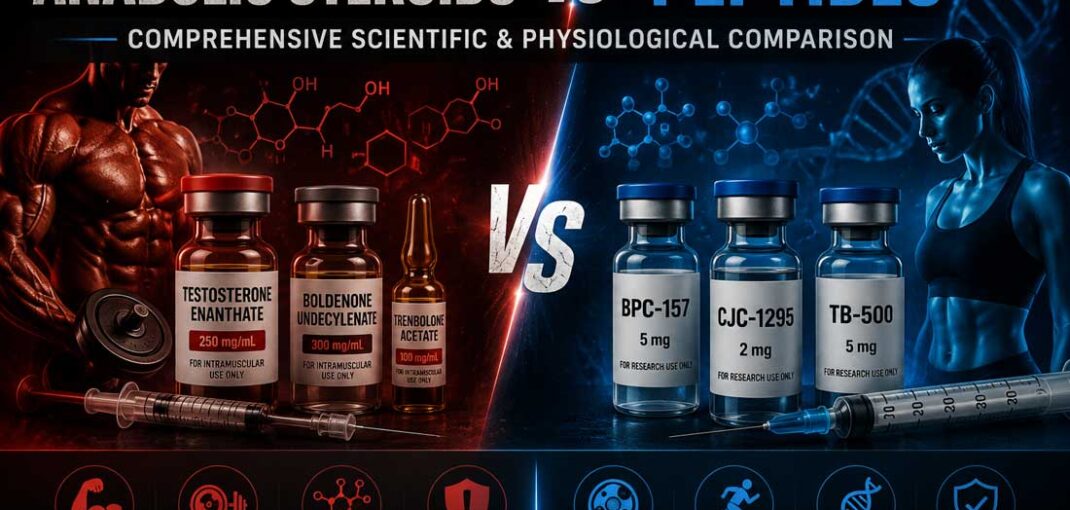
Anabolic Steroids vs Peptides: 7 Essential Differences & Risks
When comparing anabolic steroids vs peptides, it is important to understand that these compounds belong to very different biological and chemical categories. Anabolic-androgenic steroids (AAS) are steroid hormones that interact primarily with intracellular androgen receptors, while peptides are short chains of amino acids that can act on a wide range of receptors and signalling pathways.
Although both categories are discussed in relation to muscle development, recovery, metabolism, and athletic performance, their mechanisms, clinical uses, evidence bases, risks, and regulatory status are not the same. This guide explains the key differences in an anabolic steroids vs peptides comparison from a scientific and physiological perspective.
1. What Are Anabolic Steroids?
Anabolic-androgenic steroids are synthetic derivatives of testosterone. They are designed to produce anabolic effects, such as changes in protein metabolism and muscle tissue, while also producing varying degrees of androgenic effects.
Because steroid molecules are lipid-soluble, they can cross cell membranes and interact with intracellular androgen receptors. The resulting receptor complex can influence gene transcription and the expression of proteins involved in cellular and tissue function.
Medically prescribed anabolic-androgenic steroids have specific therapeutic applications. However, non-medical use for physique or performance enhancement can expose users to significant endocrine, cardiovascular, hepatic, reproductive, and psychological risks.
2. What Are Peptides?
Peptides are short chains of amino acids connected by peptide bonds. They occur naturally throughout the body and can function as hormones, signalling molecules, or components of biological pathways.
Unlike steroid hormones, many peptide-based signals interact with receptors located on the cell surface. Depending on the specific peptide, signalling may involve pathways such as cyclic AMP, phospholipase C, protein kinases, or other intracellular messenger systems.
Importantly, the term “peptide” covers a very broad group of molecules. Some peptides are established medicines, while others remain experimental or have limited human evidence. Therefore, the safety and effectiveness of one peptide cannot automatically be applied to another.
For an overview of peptide-related categories, you can explore the peptides and SARMs research catalog.
3. Anabolic Steroids vs Peptides: How Do They Work?
The molecular difference between anabolic steroids and peptides helps explain why they can produce very different physiological effects. In an anabolic steroids vs peptides comparison, the primary distinction is how each class interacts with biological receptors and signalling systems.
How Anabolic Steroids Work
- Cell entry: Many steroid molecules can cross cell membranes because of their lipid-soluble structure.
- Androgen receptor binding: The steroid can bind to the intracellular androgen receptor.
- Gene regulation: The activated receptor complex can influence gene transcription.
- Physiological effects: Changes in protein metabolism and other androgen-dependent processes can affect muscle, reproductive tissues, bone, and other organs.
How Peptides Work
- Receptor interaction: Many peptides bind to receptors on the surface of cells.
- Signal transmission: Receptor activation can trigger intracellular signalling pathways.
- Target-specific effects: Different peptides can influence different physiological processes.
- Variable biological activity: The effects depend heavily on the specific peptide, receptor, formulation, and biological context.
4. Key Differences Between Steroids and Peptides
| Parameter | Anabolic Steroids | Peptides |
|---|---|---|
| Molecular type | Steroid-based molecules | Short chains of amino acids |
| Primary signalling | Primarily intracellular androgen receptor pathways | Varies by peptide and receptor target |
| Physiological action | Direct androgenic and anabolic activity | Highly variable; may act as hormones, agonists, antagonists, or signalling molecules |
| Endocrine effects | Non-medical androgen use can suppress endogenous hormone production | Depends on the specific peptide and biological pathway |
| Evidence base | Varies considerably between medically approved drugs and non-medical use | Ranges from well-established medicines to experimental compounds |
| Safety profile | Can involve significant cardiovascular, endocrine, hepatic, reproductive, and psychological risks | Highly compound-specific; some have established safety data while others have limited evidence |
| Regulatory status | Depends on the specific substance and jurisdiction | Ranges from approved medicines to investigational or non-approved substances |
5. Muscle Growth and Body Composition
One of the most important differences in an anabolic steroids vs peptides comparison concerns their potential influence on muscle tissue and body composition.
Anabolic Steroids
Anabolic steroids directly activate androgen receptors and can substantially alter muscle protein metabolism. This is one reason non-medical anabolic steroid use is associated with increases in muscle size and strength. However, greater anabolic activity does not mean greater safety, and non-prescribed use can carry significant health consequences.
Peptides
Some peptides are investigated for their effects on metabolic signalling, growth hormone pathways, or other physiological processes. However, peptide research should not be interpreted as evidence that all peptides produce meaningful muscle growth or fat loss.
For example, growth hormone-related peptides and secretagogues have different mechanisms and evidence profiles from compounds that are marketed for tissue research. Their effects should therefore be evaluated individually rather than treating all peptides as a single category.
6. Recovery, Tendons, and Tissue Repair
Recovery is another area where anabolic steroids and peptides are often compared. However, many claims surrounding peptide-based tissue repair remain ahead of the available clinical evidence.
Compounds such as BPC-157 and TB-500 are frequently discussed in connection with connective-tissue research. Nevertheless, evidence from experimental or preclinical research should not be presented as proof of an established treatment for tendon, ligament, or muscle injuries in humans.
The FDA has noted that safety information for compounded BPC-157 is limited and has identified concerns including potential immunogenicity and issues related to peptide impurities and characterization.
7. Health and Safety Considerations
The safety comparison in anabolic steroids vs peptides should never be reduced to “steroids are dangerous and peptides are safe.” Both categories contain substances with different mechanisms, evidence levels, regulatory statuses, and potential adverse effects.
Risks Associated With Anabolic Steroids
- Suppression of natural testosterone production
- Changes in cholesterol and other cardiovascular risk markers
- Increased blood pressure and cardiovascular strain
- Changes in reproductive function and sperm production
- Liver-related concerns with certain oral compounds
- Acne, hair loss, and other androgenic effects
- Potential psychological and mood-related effects
The Endocrine Society has highlighted a broad range of potential health consequences associated with performance-enhancing drug use, including cardiovascular, endocrine, hepatic, renal, psychiatric, and musculoskeletal complications.
Risks Associated With Peptides
Peptide safety depends strongly on the individual compound. Potential concerns may include immune reactions, changes in hormone signalling, metabolic effects, interactions with other treatments, and uncertainty about long-term safety for experimental compounds.
Therefore, describing peptides as universally safer than anabolic steroids would be scientifically inaccurate. A clinically approved peptide medication with extensive human data is fundamentally different from an experimental peptide with limited safety evidence.
8. Steroids vs. Peptides in Sport
Both anabolic steroids and certain peptide hormones or growth factors can be prohibited in competitive sport. Athletes should therefore check the current anti-doping rules that apply to their sport rather than assuming that a peptide is permitted simply because it is not a steroid.
The 2026 World Anti-Doping Agency Prohibited List includes anabolic agents under S1 and peptide hormones, growth factors, related substances, and mimetics under S2. The S2 category includes examples such as growth hormone-releasing factors, growth hormone secretagogues, IGF-1, thymosin-β4 derivatives such as TB-500, and other growth-factor-related substances.
Importantly, detection and prohibited status vary by substance and sporting regulations. Athletes should consult their governing body or an appropriately qualified anti-doping professional before using any substance that may affect eligibility.
9. Anabolic Steroids vs Peptides: Which Is Better?
There is no scientifically valid universal answer to the question of which is better. In an anabolic steroids vs peptides comparison, the answer depends on the intended medical or biological purpose, the specific compound, the available clinical evidence, and the individual’s health status.
Anabolic steroids have a well-established ability to activate androgen-dependent pathways, but non-medical use carries substantial risks. Peptides represent a much broader category, ranging from established therapeutic medicines to experimental substances with limited human evidence.
For this reason, comparing an entire class of steroids with an entire class of peptides can be misleading. The most meaningful comparison is between individual compounds with clearly defined mechanisms, indications, evidence, and safety profiles.
10. Frequently Asked Questions
Are peptides safer than anabolic steroids?
Not necessarily. Some approved peptide medicines have well-established safety profiles, while some experimental peptides have limited human safety data. Likewise, anabolic steroids vary substantially in their medical uses and risks. Safety should be assessed at the individual-compound level.
Can peptides build as much muscle as anabolic steroids?
Peptides are a diverse category, so there is no single answer. Some peptides influence growth hormone or metabolic signalling, but they should not generally be considered equivalent to anabolic steroids in their direct androgen-receptor activity or muscle-building effects.
Do peptides suppress testosterone?
It depends on the specific peptide and its biological target. It is incorrect to assume that every peptide has the same effect on reproductive hormones. Compounds that influence endocrine signalling can have different effects from peptides with other biological targets.
Are peptides legal in sport?
Some peptide hormones, growth factors, and related substances are prohibited by WADA. Athletes should check the current Prohibited List and the rules of their specific sporting organization before using any peptide-related substance.
Are BPC-157 and TB-500 approved treatments for injuries?
Claims about these compounds should be interpreted cautiously. Preclinical findings do not establish that a substance is an approved or proven treatment for human tendon, ligament, or muscle injuries. Regulatory status and clinical evidence should always be checked before making therapeutic claims.
What is the main difference between steroids and peptides?
The fundamental difference is their molecular structure and signalling mechanism. Steroids are lipid-soluble molecules that commonly act through intracellular steroid receptors, while peptides are amino-acid chains that can interact with many different cell-surface or intracellular targets. Their physiological effects and safety profiles therefore vary considerably.
11. Final Takeaway
The anabolic steroids vs peptides comparison involves two fundamentally different classes of biological compounds. Steroids primarily exert androgenic and anabolic effects through intracellular androgen receptors, whereas peptides can influence a wide variety of signalling pathways depending on their structure and target.
The most important point is that neither category should be treated as a single, uniform group. Medical approval, clinical evidence, mechanism of action, regulatory status, and safety can vary significantly between individual compounds.
For anyone researching these substances, evidence-based medical information and appropriate professional guidance are more reliable than marketing claims or anecdotal reports. In competitive sport, current anti-doping regulations should also be checked before considering any hormone, peptide, or performance-enhancing substance.


