
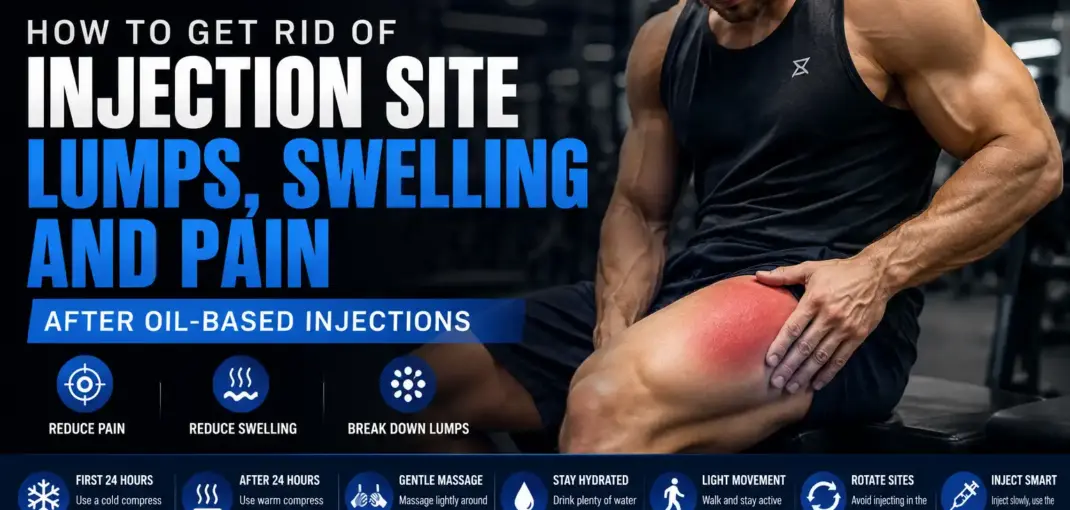
Injection Site Lumps After Oil-Based Injections: Causes, Relief & Prevention
Introduction
Injection site lumps can be an uncomfortable and worrying reaction after an oil-based intramuscular injection. Some people notice a small hard area, swelling, tenderness, tightness or soreness around the injection site.
In many cases, mild post-injection discomfort improves gradually without treatment. However, the severity and duration of a reaction can vary depending on the injection, the amount administered, the injection site and individual factors.
Understanding the possible causes of injection site lumps, knowing how to support comfort during recovery and recognising warning signs can help you decide when simple self-care may be appropriate and when medical advice is needed.
This guide explains common causes of injection site swelling and pain, practical recovery measures, prevention considerations and symptoms that should not be ignored.
Why Do Injection Site Lumps Occur?
An injection site lump can develop when tissue reacts to an injection or when injected oil remains temporarily concentrated within the tissue.
Possible contributing factors include:
- Local tissue irritation
- Inflammation following the injection
- Injection volume
- The properties of the oil-based formulation
- Individual sensitivity
- Injection technique
- Repeated use of the same area
A small, mildly tender lump may gradually become less noticeable as the local reaction settles.
However, not every lump has the same cause. A persistent, increasingly painful or rapidly enlarging lump should be assessed by a healthcare professional.
Why Does Injection Site Swelling Happen?
Some swelling after an injection can occur as part of the body’s local inflammatory response.
Temporary irritation may result in:
- Mild swelling
- Tenderness
- Tightness
- Local warmth
- Redness
The degree of swelling varies between individuals.
Mild swelling that gradually improves is generally less concerning than swelling that continues to increase, becomes very painful or is accompanied by fever or drainage.
What Causes Post-Injection Pain?
Post-injection pain is commonly described as soreness or tenderness around the injection site.
Several factors may influence how uncomfortable an injection feels, including:
- Injection volume
- Injection location
- Individual sensitivity
- Tissue irritation
- Formulation characteristics
- Injection technique
Some people experience only mild soreness, while others may have discomfort that lasts for several days.
The important factor is the overall pattern. Pain that steadily improves is different from pain that becomes increasingly severe.
7 Ways to Support Recovery From Injection Site Lumps
1. Use a Cold Compress for Early Swelling
A cool compress may help provide temporary relief from mild swelling and discomfort during the early period after an injection.
If you use a cold pack:
- Wrap it in a clean towel.
- Avoid placing ice directly on the skin.
- Use it for short periods.
- Stop if the skin becomes excessively numb or painful.
Cold therapy is primarily intended to improve comfort rather than remove the underlying cause of a lump.
2. Consider Gentle Warmth Later
Once the initial irritation has settled, some people find gentle warmth more comfortable.
A warm shower or warm compress may help relax the surrounding tissue and improve comfort.
Avoid excessive heat, particularly if the area is already very red, hot or significantly swollen. Increasing warmth in combination with worsening redness can be a warning sign of infection and should not simply be treated with more heat.
3. Keep Moving Gently
Light movement can help prevent stiffness and maintain normal daily activity.
Depending on your symptoms, suitable low-intensity activities may include:
- Walking
- Gentle movement
- Normal daily activities
There is no need to force exercise through significant pain.
If movement causes a noticeable increase in pain or swelling, reduce activity and allow the area to recover.
4. Avoid Aggressive Massage
Massage is sometimes suggested as a way to reduce an injection lump, but forceful pressure can further irritate already sensitive tissue.
If the area is tender:
- Avoid deep pressure.
- Do not repeatedly press the lump.
- Stop if massage increases pain.
- Avoid manipulating an area that is hot, severely swollen or increasingly red.
A painful or worsening lump should be medically assessed rather than repeatedly massaged.
5. Stay Hydrated
Adequate hydration supports normal body function and general recovery.
Rather than relying on excessive amounts of water, aim for normal hydration according to your individual needs and activity level.
Hydration alone will not remove an injection site lump, but it is an important part of general recovery and wellbeing.
6. Give the Area Time to Recover
One of the simplest strategies is to avoid repeatedly irritating the affected area.
If the injection site remains sore:
- Avoid unnecessary pressure.
- Avoid repeated injections into the same irritated area.
- Allow symptoms to settle before placing additional stress on the tissue.
Persistent symptoms should be evaluated rather than repeatedly treated at home.
7. Monitor the Area
Keep an eye on the size, colour, temperature and tenderness of the affected area.
A mild reaction that gradually improves is generally different from one that becomes progressively worse.
Useful things to monitor include:
- Is the lump getting smaller?
- Is the pain improving?
- Is redness spreading?
- Is swelling increasing?
- Is the area becoming hotter?
- Is there any drainage?
Changes over time can help identify when professional assessment may be appropriate.
Can Warming an Oil-Based Injection Reduce Discomfort?
Some people believe that bringing an oil-based formulation closer to room temperature may make administration more comfortable.
However, formulations differ, and products should always be handled according to their specific instructions.
Do not heat injectable products with boiling water, microwaves, direct flames or other uncontrolled heat sources.
If the product instructions do not specifically recommend warming, it is safer not to improvise with temperature changes.
Does Injection Speed Affect Post-Injection Pain?
Injection technique can influence local discomfort, but there is no single technique that is appropriate for every injectable product.
The correct administration method depends on the medication or substance, formulation, route and clinical instructions.
If an injection has been prescribed, follow the administration instructions provided by the prescribing clinician or pharmacist rather than relying on general online injection protocols.
Can Injection Volume Cause a Lump?
Injection volume can be one factor associated with local discomfort and tissue pressure.
A larger amount of fluid or oil introduced into a small area may produce more local pressure or irritation in some circumstances.
The appropriate volume depends entirely on the specific product and its intended route of administration.
Do not change the volume of a prescribed or injectable product without appropriate professional guidance.
Why Is Injection Site Rotation Important?
Repeatedly using the same injection site can expose the same tissue to repeated irritation.
For prescribed intramuscular injections, healthcare professionals may recommend appropriate site rotation depending on the medication and injection technique.
Do not assume that every injection site is suitable for every product.
If you are unsure where or how a prescribed injection should be administered, ask a qualified healthcare professional.
Common Mistakes That Can Make Injection Site Reactions Worse
Repeatedly Pressing the Lump
Constantly touching or squeezing an irritated area can increase discomfort.
Aggressive Massage
Deep massage may further irritate inflamed tissue.
Exercising Through Severe Pain
Training a severely painful area may make symptoms more uncomfortable.
Repeatedly Using an Irritated Site
Allowing tissue to recover can be important when local irritation occurs.
Ignoring Worsening Symptoms
A reaction that becomes progressively worse should not automatically be assumed to be normal post-injection soreness.
Nutrition and General Recovery
There is no specific food that can immediately remove an injection site lump, but a balanced diet supports normal recovery and overall health.
Protein
Adequate protein contributes to normal tissue maintenance and repair.
Useful sources include:
- Chicken
- Turkey
- Fish
- Eggs
- Greek yoghurt
- Lean meat
- Cottage cheese
Fruit and Vegetables
A varied diet containing fruit and vegetables provides fibre, vitamins and minerals that support general health.
Healthy Fats
Examples include:
- Olive oil
- Avocado
- Nuts
- Seeds
- Oily fish
Hydration
Maintaining normal hydration is another basic part of supporting overall wellbeing.
Should You Use Supplements for Injection Site Pain?
Supplements are not a proven treatment for an injection site lump or suspected injection-related infection.
Products such as magnesium, vitamin D or omega-3 supplements may have roles in general nutrition when appropriate, but they should not be presented as a way to directly treat an injection site reaction.
If you have persistent or severe symptoms, medical assessment is more appropriate than relying on supplements.
When Should You Seek Medical Advice?
Most mild injection reactions improve with time, but some symptoms require professional assessment.
Seek medical advice if you develop:
- Increasing or severe pain
- Rapidly increasing swelling
- Spreading redness
- Significant warmth around the area
- Fever
- Chills
- Pus or other drainage
- Red streaks extending from the injection site
- Significant weakness or feeling unwell
- A lump that continues to grow or does not improve
These symptoms can indicate a more significant reaction, including a possible infection or abscess.
If symptoms are severe or you feel seriously unwell, seek urgent medical care.
How Long Do Injection Site Lumps Last?
There is no single recovery time for an injection site lump.
A mild local reaction may improve over several days, while a more persistent lump can take longer to settle.
The most useful indicator is the direction of change.
If the lump and discomfort are gradually improving, that is generally more reassuring than symptoms that are becoming progressively worse.
Factors that can affect recovery include:
- The injected formulation
- Injection volume
- Injection location
- Tissue irritation
- Individual response
- Whether the area has been repeatedly irritated
Persistent or worsening symptoms should be evaluated by a healthcare professional.
How Can Injection Site Lumps Be Prevented?
Prevention depends on the specific injectable product and the correct administration method.
For prescribed injections, follow the instructions provided by your healthcare professional.
General principles include:
- Use the correct administration technique.
- Follow product-specific instructions.
- Avoid injecting into visibly irritated tissue.
- Follow appropriate site-rotation guidance.
- Do not exceed the recommended volume.
- Maintain appropriate hygiene.
- Never reuse needles or injection equipment.
Correct technique and sterile equipment are particularly important for reducing avoidable injection-related complications.
Frequently Asked Questions
Is it normal to get an injection site lump after an oil-based injection?
A small lump can occur after some oil-based injections and may gradually improve. However, a lump that becomes increasingly painful, hot, red or swollen should be assessed by a healthcare professional.
How can I reduce injection site swelling?
A cool compress may provide comfort during early swelling. Later, gentle warmth may feel more comfortable for some people. Avoid excessive heat or aggressive massage, particularly if symptoms are worsening.
How long does injection site pain last?
Mild soreness may improve within several days, but recovery varies. Persistent or worsening pain should not be ignored.
Should I massage an injection site lump?
Avoid aggressive massage. Pressing or repeatedly manipulating a painful lump can increase irritation.
Is heat or ice better for an injection site reaction?
A cool compress may help with early swelling, while gentle warmth may be more comfortable later. The appropriate approach depends on the symptoms. Increasing heat, redness and swelling can be warning signs that require medical assessment.
Can I exercise after an injection?
Light movement may be comfortable for some people, but severe pain is a reason to reduce activity and allow recovery. Follow product-specific or clinician-provided instructions for prescribed injections.
How can I prevent injection site lumps?
Following correct administration instructions, using appropriate injection sites, maintaining hygiene and allowing irritated tissue to recover may help reduce the risk of local reactions.
When is an injection site lump dangerous?
A lump accompanied by severe or increasing pain, spreading redness, significant warmth, fever, pus, rapidly increasing swelling or feeling unwell requires medical assessment.
Final Thoughts
Injection site lumps after oil-based injections can be uncomfortable, but mild local reactions may improve gradually as the tissue settles.
Simple measures such as appropriate cold or gentle warmth, normal movement, adequate hydration and avoiding unnecessary irritation may help improve comfort.
However, not every lump is simply a normal post-injection reaction. Increasing pain, spreading redness, significant warmth, pus, fever or rapidly worsening swelling can require medical attention.
When in doubt, particularly after a prescribed medication or injection, speak with a qualified healthcare professional for advice specific to the product and your circumstances.


